
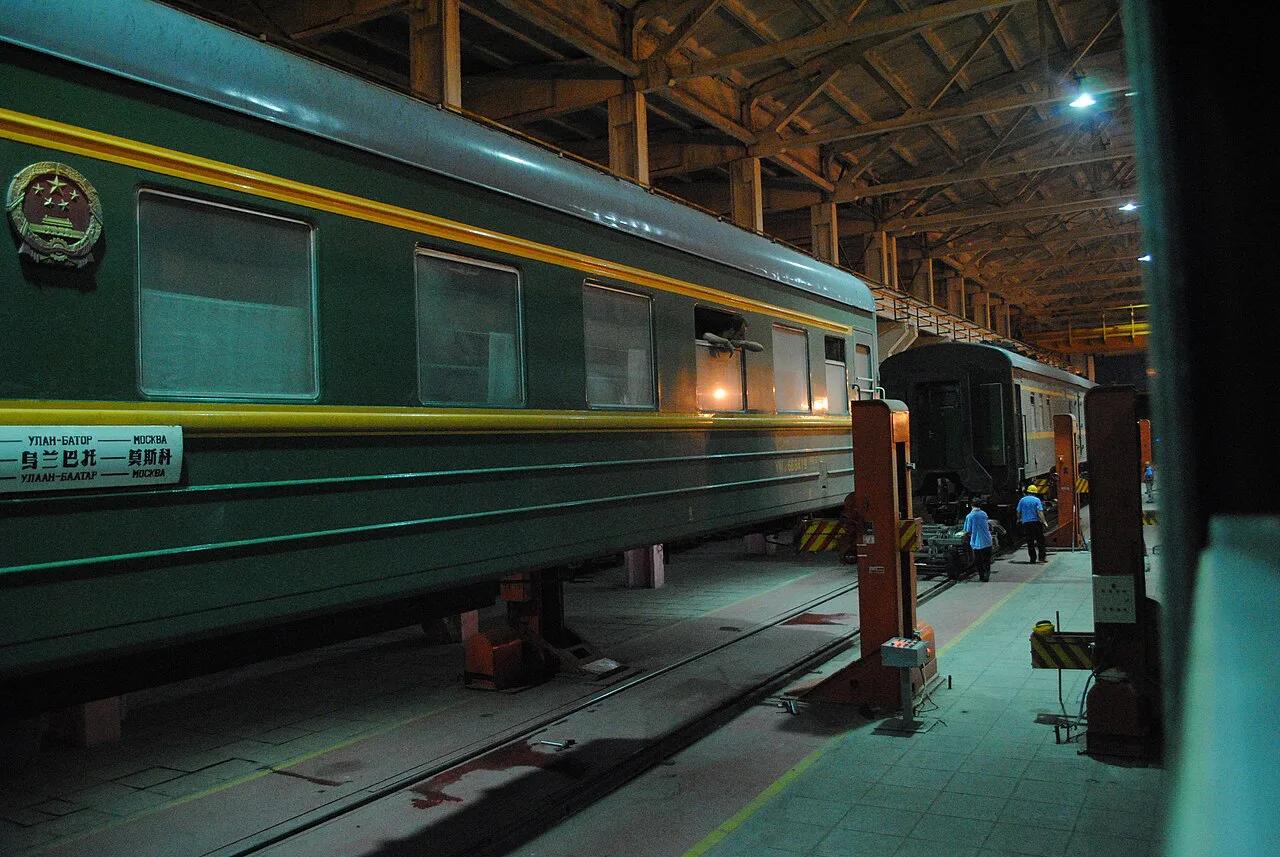
Trains in Mongolia: Routes, Tickets & How to Choose
Which trains run in and through Mongolia? Compare the Beijing–Ulaanbaatar and Ulaanbaatar–Russia routes, booking tips and train-versus-other-transport trade-offs.
On this page
Last updated November 2026: trains in mongolia fall into three groups. These are international services on the Trans-Mongolian line, domestic passenger trains run by the national operator, and the question of whether rail suits your trip at all. Use the table below to pick your route, then jump to the section that matches.
Featured image: Matt Doughty, CC BY 2.0, via Wikimedia Commons.
Quick answer: which train do you need?
Most visitors want the cross-border run between Beijing and Ulaanbaatar. Travelers continuing to Russia want the Ulaanbaatar–Irkutsk leg. The full Beijing–Moscow through trains have been suspended since 2020. Domestic trains are a separate, smaller story. For the first route, start with our Beijing to Ulaanbaatar guide. Timetables and fares change, so treat the table as a routing aid and read current schedules on the operator sites.
| Route | Who it suits | Booking difficulty | Where to read more |
|---|---|---|---|
| Beijing to Ulaanbaatar | First-timers with limited time | Higher in summer and Chinese holidays | Beijing to Ulaanbaatar guide |
| Ulaanbaatar to Irkutsk | Trans-Siberian travelers heading into Russia | Moderate; two operators involved | Ulaanbaatar to Irkutsk guide |
| Beijing to Moscow | Not running: the through trains (K3/K4, K19/K20) have been suspended since 2020 | Not bookable as one train; the Beijing–Ulaanbaatar and Ulaanbaatar–Irkutsk legs run separately | Beijing to Moscow guide |
| Domestic Mongolian services | Travelers staying inside Mongolia | Depends on route; limited coverage | UBTZ timetable |
The Trans-Mongolian route in plain terms
The Trans-Mongolian route links Beijing to Russia by crossing Mongolia. It runs through Ulaanbaatar and joins the Russian rail network at the border town of Sukhbaatar. On the south side, the Mongolian main line ends at Zamyn-Uud. Other Trans-Siberian variants avoid Mongolia entirely. The Trans-Manchurian route, for example, stays in China before entering Russia. Both through services (K3/K4 Trans-Mongolian and K19/K20 Trans-Manchurian) have been suspended since 2020, so today the Mongolian route means riding it in legs: Beijing to Ulaanbaatar, then Ulaanbaatar to Irkutsk.
Beijing to Ulaanbaatar by train
This is the route most travelers mean when they search for trains in mongolia. Services cross the border overnight, and the border stop includes passport and customs checks. Expect to be woken for inspections. The Beijing–Ulaanbaatar train is K23 (K24 on the return). It runs weekly, on Saturdays from Beijing since 4 June 2026, and takes about 31 hours. It resumed on 3 June 2025 after the 2020 suspension. Seats are sold through agents and at stations, and availability tightens during summer vacations and Chinese national holidays. Our full route guide covers the border process in more detail. The international train does not run daily, so plan around the Saturday departure.
- Book the China-side leg first, since that is where peak-season scarcity bites.
- Reserve your Ulaanbaatar hotel only after the train ticket is confirmed.
- Keep passports and visa paperwork within reach for night-time checks.
Ulaanbaatar onward to Russia
From Ulaanbaatar the line continues north through Sukhbaatar into Russia. The most common onward stop is Irkutsk, covered in our Ulaanbaatar to Irkutsk guide. Russian-side details sit with Russian Railways, while the Mongolian section is managed by Ulaanbaatar Railway. Do not assume one operator sells every leg. If you want to go all the way, read our Beijing to Moscow guide before you commit to separate tickets.
Domestic trains inside Mongolia
Mongolia has a compact rail network built around one main line. That line runs from Sukhbaatar through Ulaanbaatar to Zamyn-Uud, with domestic passenger services operated by UBTZ. Coverage is thin compared with China or Russia. Large parts of the country, including the western provinces and the Gobi's remote areas, have no passenger rail. Tourists can use domestic services on the main-line corridor, but timetables and ticket sales are mostly set up for local passengers. Check the UBTZ site for current departures. For national parks and the steppe, most visitors rely on road transport instead.
Train vs bus vs flight vs tour
Rail makes sense when the journey itself is the point. For reaching remote areas inside Mongolia, it rarely does. Costs here are relative, since fares move with season and class.
| Option | Cost level | Time | Comfort and scenery | Flexibility |
|---|---|---|---|---|
| Train | Mid-range | Long but overnight | Berth, window views | Fixed departures |
| Bus or shared vehicle | Low | Long and variable | Basic seating | Frequent departures on some routes |
| Flight | Highest | Shortest | Little scenery | Fewer cities served |
| Guided tour | Highest overall | Set by itinerary | Transport handled for you | Low; fixed route |
- Choose the train if you want a border crossing with no airport queues and an overnight berth.
- Choose the train if you are linking Beijing, Ulaanbaatar and Russia on one trip.
- Skip the train if you need the Gobi, Terelj or western Mongolia.
- Skip the train if you are short on days and cannot absorb a delay at the border.
Tickets, booking windows and seasons
Buy as early as the operator allows. Summer vacations and Chinese national holidays are the tightest periods for China-side tickets. Groups can be split across carriages and may be given top berths, so never assume lower berths. Book separately for each country if the operators do not sell through tickets. Prices and booking rules were checked November 2026, and current fares are on the operator sites. Bring snacks, a charged phone and printed confirmations. Allow a buffer day in Ulaanbaatar before any onward connection.
China-side tickets are sold through China Railway's 12306 site, so book that leg early, since summer and holiday demand is highest there.
Borders, visas and paperwork
Rules for transit and entry depend on your passport and change over time. Use official government and border-agency pages for the visa position. Your train will stop at the border for passport checks, and customs officers may walk the carriages. Sort visas for every country on your route before you buy any ticket. A rejected visa after a non-refundable booking is the costliest mistake in this guide.
Mistakes to avoid
Most problems on this route come from planning, not from the train.
- Assuming one operator sells every leg of a Beijing–Russia trip.
- Underestimating border delays and booking tight onward connections.
- Expecting a lower berth on a peak-season departure.
- Buying tickets before confirming visas.
- Planning domestic rail trips to places the network does not reach.
Pair this with our broader tourism attractions guide for the full city overview.
Frequently Asked Questions
Does Mongolia have a train system?
Yes. Mongolia has a rail network centered on one main line from Sukhbaatar through Ulaanbaatar to Zamyn-Uud. Domestic passenger services run on it, and coverage is limited to that corridor and its branches.
How do I get to Mongolia?
Most visitors fly into Ulaanbaatar. Another option is the overnight train from Beijing, which crosses the border with passport and customs checks. Our Beijing to Ulaanbaatar guide explains how to book it.
Notes on Asia's railways
Optional updates when we revise our train and route guides.
You might also like

Continue reading
More guides you'll find useful